The Intelligence Shift: As AI Expands IQ, Humans Must Expand EQ and SQ
Updated April 3, 2026
Why understanding people (social intelligence) matters more than ever
⚡ Quick Take
As AI handles more information processing, IQ alone is no longer the human advantage it once was.
Emotional intelligence (EQ) and social intelligence (SQ) are becoming the most valuable skills of the AI era.
The rise of AI may actually help us become better human beings by freeing us up to focus on what only humans can do: understand each other.
I immigrated to the United States from the Philippines at 16. No social media. No Google. No way to instantly learn how a new culture worked.
What I had was observation.
I watched how people communicated. How groups interacted. How cultural norms quietly shaped everything. I arrived as a newcomer…and learned to read rooms, shift, and connect.
A boss once pulled me aside and said, “I can put you in front of anyone, and you can relate to them, regardless of age, gender, or background.”
She was describing social intelligence before I even had a name for it.
I’m sharing that story because what I developed out of necessity then is becoming one of the most valuable human skills in the AI era now.
💡 And what I’m sharing here isn’t just a reflection. It’s my prediction for the next five years (maybe even sooner, with how fast AI is advancing) as it reshapes how we think, work, and connect.
We’re living through a quiet shift in intelligence.
For years, intelligence meant one thing: how well we could remember, solve, and process information. That’s what we’ve called IQ. Schools still test for it. Careers reward it. Society values it.
And it made sense because information was limited, access was slow, and knowing more gave us an advantage.
But something is changing.
With AI tools like ChatGPT, Claude, and Gemini, we don’t just search anymore; we get answers. Summaries. Ideas. Even decisions. Faster than ever before.
AI is now handling the heavy lifting of information processing and implementation.
So here’s the irony most people miss:
👉 AI may actually help us become better human beings.
How?
As AI takes over more thinking tasks and busywork, it removes us from the work that has been consuming our time, away from what matters most.
That’s human value shifting from what we know to how we relate to others.
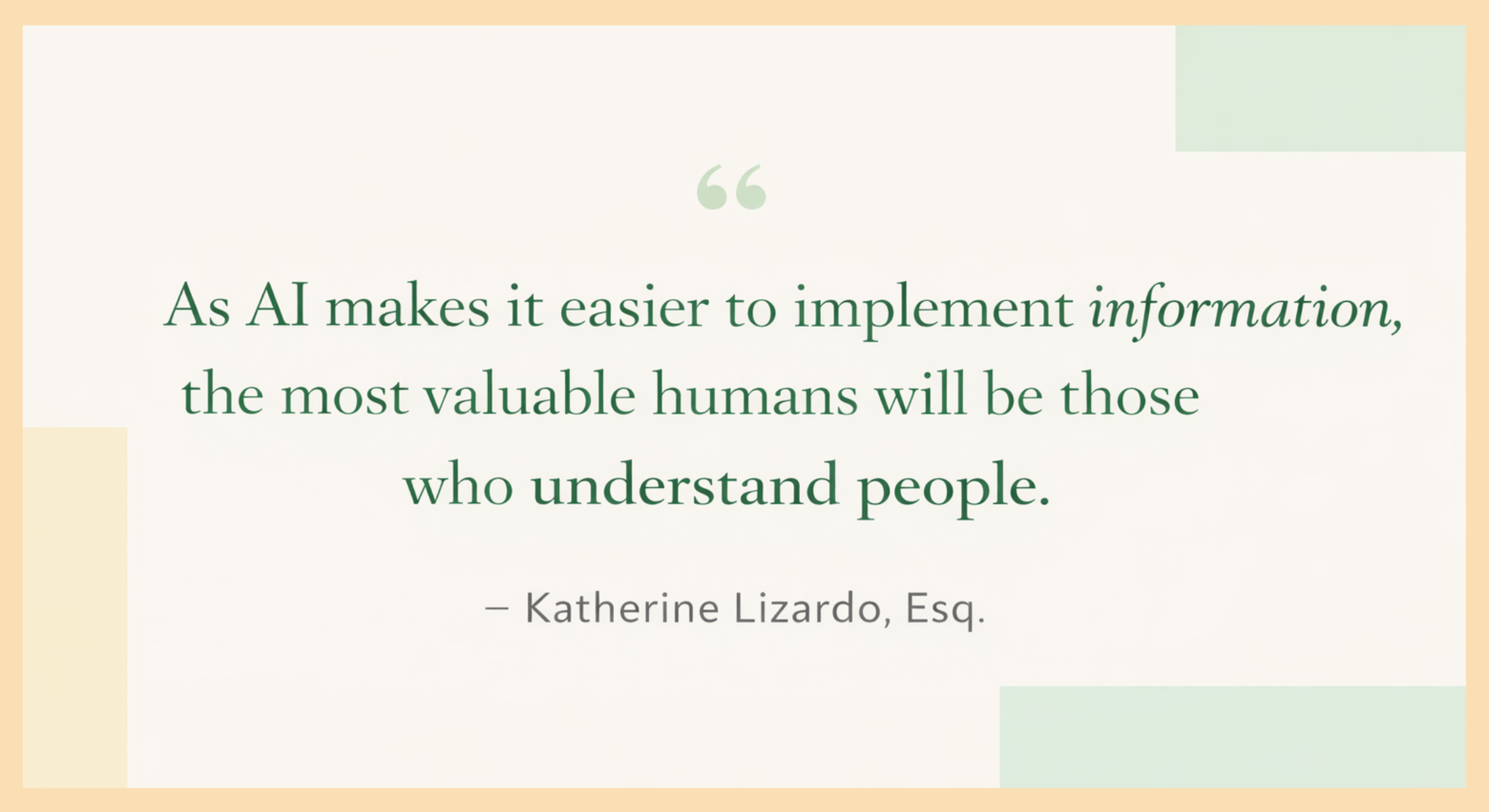
“As AI makes it easier to implement information, the most valuable humans will be those who understand people.”
What is the difference between IQ, EQ, and SQ?
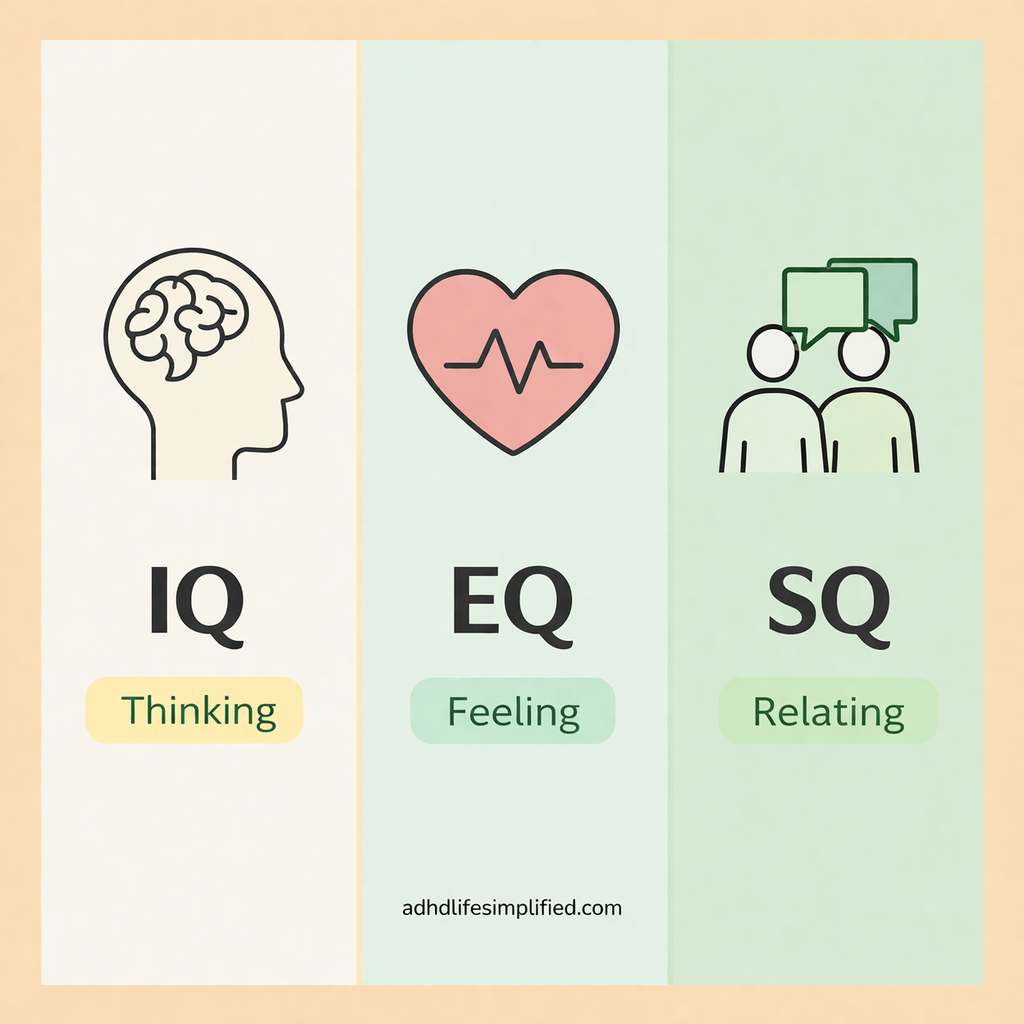
Human intelligence is evolving from a focus on IQ toward emotional intelligence (EQ) and social intelligence (SQ). Each one addresses a different dimension of how we function in the world.
Here’s my simplified definition grounded in neuroscience.
🧠 IQ — Intelligence Quotient: about the outside world
IQ is our ability to process information, solve problems, and think logically. It’s how we understand, learn, and analyze the world around us.
This is where AI is accelerating rapidly. And as it does, IQ alone is no longer the differentiator it once was.
❤️ EQ — Emotional Intelligence: about you
EQ is our ability to understand and regulate our own emotions — and to use that awareness to shape our thoughts, words, and actions.
Many children are now being taught this in school. People are even posting about this on social media. Adults are becoming more open to learning it. That’s a positive shift. But there’s still a long way to go to make it part of our way of life.
🤝 SQ — Social Intelligence: about us
SQ is the ability to understand people in real-life situations — to read social cues, know what to say (or not say) and when, knowing when to step in or step back, navigate group dynamics, and interact wisely across different social environments.
Social intelligence isn’t about being nice or polite. That’s manners.
“Social intelligence is about noticing what’s happening, understanding it, and choosing what to do next in the best interest of everyone involved.”
This is the piece most people haven’t heard of yet — and the one that will matter most.
Simplified:
🧠 IQ is about our outside world — how we understand, learn, and analyze information
❤️ EQ is about us internally — how we regulate our own emotions, which shape our thoughts, words, and actions
🤝 SQ is about us collectively — how we understand ourselves in relation to others, so we can interact wisely in every environment we navigate
🌎 In an increasingly interconnected world, social intelligence is becoming one of the most valuable human abilities. The advantage is no longer just thinking faster. It’s about understanding human beings better.
How did we get here? A brief timeline.
1905 — Psychologists Alfred Binet and Théodore Simon developed the first practical intelligence test, later known as the Binet-Simon Scale. This marked the introduction of IQ—general cognitive ability, including reasoning, learning, and problem-solving.
1920 — Psychologist Edward L. Thorndike introduced the term social intelligence as “the ability to understand and manage men and women, boys and girls—to act wisely in human relations.” Edward L. Thorndike, “Intelligence and Its Uses,” Harper’s Magazine, 1920. This marked the first formal introduction of “social intelligence” in psychology.
1995 — Psychologist Daniel Goleman popularized emotional intelligence in his bestselling book, Emotional Intelligence: Why It Can Matter More Than IQ. This marked a global shift toward emotional skills in leadership, relationships, and personal development.
1998 — Google was launched, making instant access to information possible. This marked a major shift in how humans find and use knowledge.
2006 — Goleman published Social Intelligence: Beyond IQ, Beyond Emotional Intelligence, expanding social intelligence to include social awareness (“what we sense about others”) and social facility (“what we then do with that awareness”).
2022 — ChatGPT launched publicly, accelerating not just access to information but the ability to turn it into action. This marked another major shift—from information to execution.
Now — AI no longer simply answers questions. It summarizes, strategizes, and even makes decisions. This marks a new phase—where technology not only provides information, but executes on it.
So the real question becomes:
“What does that free us—human beings—to become?”
How is human intelligence evolving in the age of AI?
As artificial intelligence accelerates information access and implementation, the uniquely human abilities of empathy, compassion, and social awareness are becoming increasingly valuable.
The more powerful AI becomes, the more valuable human intelligence becomes…not the kind that processes data, but the kind that understands people.
💡 Pause for a second…
If AI is getting better at thinking…
And schools are teaching emotional awareness…
This is what I found myself asking…
“Who is teaching our kids how to understand people: in real conversations, real friendships, real moments?”

Think of it this way:
AI can help our child solve a math problem.
But it can’t tell our children why a friend stopped talking to them.
It doesn’t know if someone is overwhelmed, hurt, confused, or shutting down.
It can’t read the room at lunch.
It doesn’t knows when to step in—or step back when two friends are fighting.
AI can tell us what to say.
But it can’t tell us how it will land.
That’s the kind of understanding we’re talking about.
That’s human intelligence at work.
That’s where social intelligence lives.
And this is where everything starts to come together, not just in theory, but in how we show up with each other every day.
So, the real shift:
As AI handles more IQ…
Human intelligence begins to expand in a different direction.
And that direction is toward each other.

Where does this leave us?
Preparing for the AI-Human Intelligence Paradox can reshape how we lead at work, how we raise the next generation, and how we show up in our families and communities.
If you’re reading this and thinking:
“Okay… but how do I actually help my child learn this?”
That’s exactly what I’ve been working on behind the scenes.
I’m walking through this step-by-step in a free live training for parents, in a way that’s simple and grounded in real-life moments.
If you want to explore that with me, you can save your spot here.
Final Thoughts:
Social intelligence has been my personal “secret weapon” — the skill that helped me adapt, collaborate, and connect with whomever and wherever I went. Not because I had a formula, but because I was genuinely curious about people.
And I believe that curiosity is something we can all cultivate.
❓ I’d love to hear from you:
Do you think emotional intelligence and social intelligence will become the most valuable human skills in the AI era?
There’s no right or wrong answer here. I’m starting a conversation.
This is where the deeper conversation continues:
👉 Inside our free Thriving ADHD Mompreneurs community — where we’re exploring social intelligence, real-life parenting moments, and practical ways to understand people—together. See you inside!
I appreciate you. 🙏